

UX and insight leaders today are caught between two contradictory expectations: deliver deeper, more continuous understanding of users, while operating with limited time, budget, or team capacity. Many teams are one researcher supporting five or more product squads. Some have no researchers at all.
And yet the demand doesn’t shrink. Product owners, designers, marketing leads—they all want faster answers about user needs, behavior, and friction points. What used to be a dedicated research cycle is now a Slack thread: “Hey, do we have any data on this?”
In this environment, scalable insight isn’t a luxury, it’s a survival tool.
That’s where AI panels come in.
Why AI Panels Matter for UX Teams
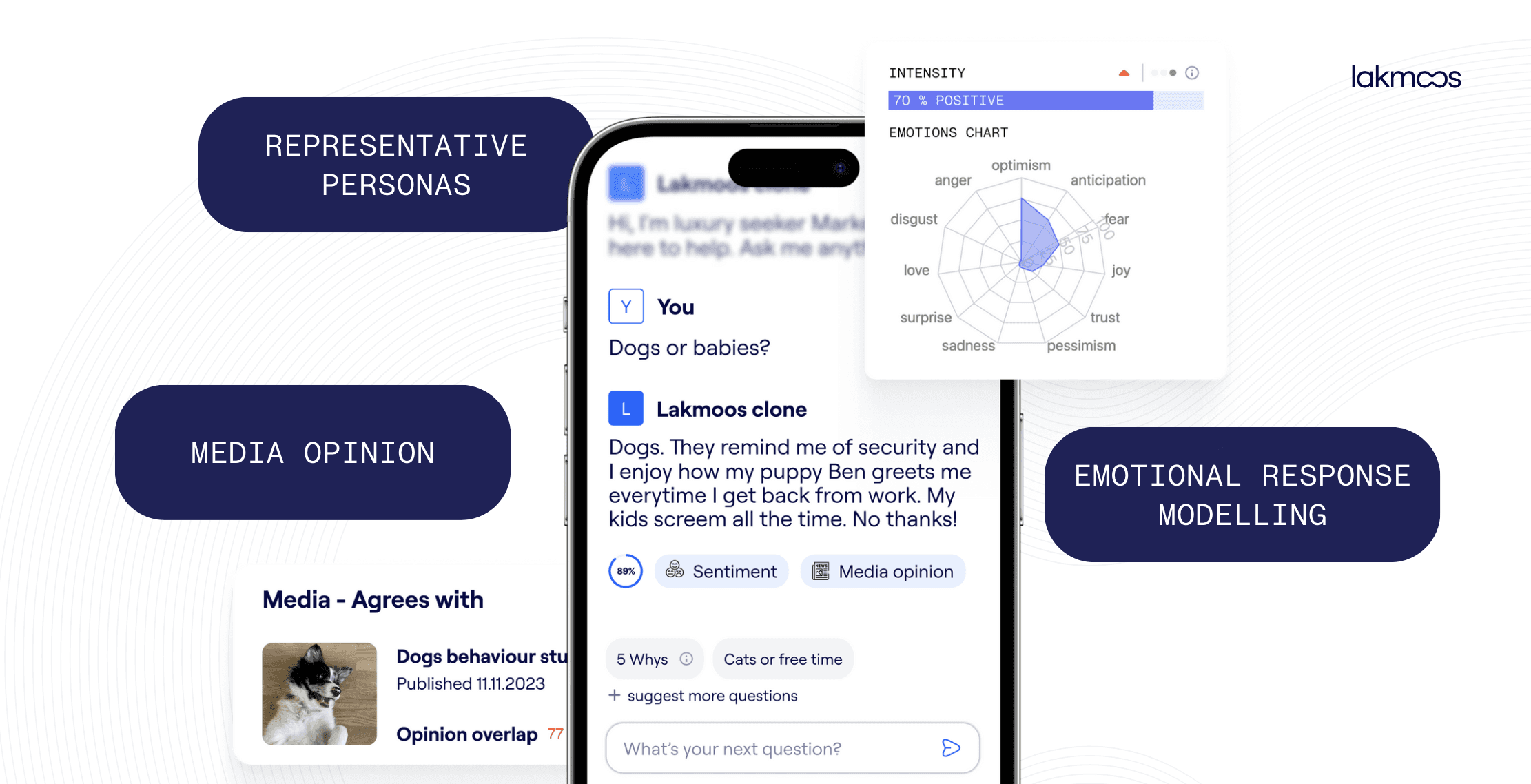
AI panels simulate the behavior, decision-making logic, and emotional reactions of specific user types. They are not personas. They are not chatbots. They are structured, behaviorally grounded user models that can be queried instantly.
For UX researchers, this changes the game in three ways:
Faster Early-Stage Discovery
No more delaying ideation until you have time to recruit. AI panels let you pressure-test ideas with behaviorally rich segments in real time.Democratized Asking, Centralized Standards
Non-researchers can ask smart questions without bypassing UX, because the logic model stays controlled, explainable, and aligned to shared segments.Scalable Simulation for Edge Cases
Want to explore friction for a low-trust, neurodiverse, or mobile-only segment? AI panels make this accessible without relying on anecdotal extrapolation.
Real-World Examples
A UX lead in a financial services team uses Lakmoos to simulate onboarding flows for digitally hesitant older adults, without needing a separate qual study.
A solo researcher at a B2B SaaS company uses AI panels to model objections for mid-funnel conversion, across four buyer mindsets.
A cross-functional team pressure-tests UI copy with skeptical, privacy-conscious users ahead of a new data permission interface.
These aren’t hypotheticals. They’re how under-resourced teams keep discovery alive, even when bandwidth disappears. → Get inspiration from our clients Volkswagen Group and Raiffeisenbank.
AI panels are:
Logic-based, behaviorally anchored simulations of human responses
Accessible across teams without diluting UX standards
Built to answer specific product and design questions at speed
AI panels are not:
Chat-GPT chatbots trained on internet content
Replacements for in-depth qual when emotional nuance is critical
Static personas that go stale after one sprint
The goal isn’t to replace research. It’s to restore research capacity, without the bottlenecks.
Start Without Losing Control
If you’re a UX or research lead, you don’t need to “roll out AI” overnight. You can begin by:
Identifying 2–3 moments per sprint where teams usually guess instead of test
Running AI panel tests yourself, then sharing the logic + results
Inviting one product partner to try it with a fixed behavioral segment
Using the maturity model to identify where your org is in insight fluency
You stay in control of logic, interpretation, and learning. The system just makes it scalable.
AI panels give UX leaders a new kind of leverage: not more people, but more repeatable capacity. They enable what most teams desperately need, a way to bring users back into the process without burning out the research function.
The question isn’t whether synthetic respondents can replace good research. The question is: can your team keep up without them?