

The AI panel space is growing fast. From VCs to insight teams, there’s clear momentum behind synthetic respondents and machine-driven user research. Tools like Aaru, Artificial Societies, bluepill, Keplar, Lakmoos AI, Native, Persona, Simulatrex, Simile, subconscious.ai, Synthetic Users, and ViewpointAI all explore some version of “AI-powered customer simulation.” Many are sleek. Some move impressively fast. And a few offer genuinely interesting ideas.
But most still rely on large language models like GPT to generate responses, essentially acting as structured prompt systems without deeper behavioral architecture. You’ll often get answers that sound realistic, but they’re generated by predicting likely language, not modeling real decision-making. In some use cases, that’s perfectly sufficient. But when the stakes are higher, launch decisions, brand risk, segment prioritization, it’s worth asking: Can this system explain how it thinks?
A “GPT wrapper” typically refers to a tool that looks like a research platform but functions by sending prompts to an underlying model like ChatGPT. It may produce fast, fluent outputs, but those outputs aren’t grounded in consistent logic or segment fidelity. For early ideation, that’s helpful. For strategic research, it’s limited.
💡 An AI panel is a synthetic sample of respondents trained on real-world data to simulate human decisions at scale, without needing fieldwork.
🧠 A GPT Wrapper Is Not a Research Tool
We’ve all seen it:
“Pretend you're a 42-year-old engineer living in Manchester. Do you like this ad?”
You might get a clever-sounding answer. But let’s be honest, GPT doesn’t know your customer. It knows autocomplete. These systems weren’t built to simulate humans. They were built to predict the next word based on a trillion online sentences. They can’t reason. They don’t remember. They don’t replicate. And yet, they’re being used to inform million-euro business decisions.
This isn’t synthetic research. It’s synthetic confidence.
GPT wrappers are great at language. But you do not care about language, you care about prediction and behaviour.
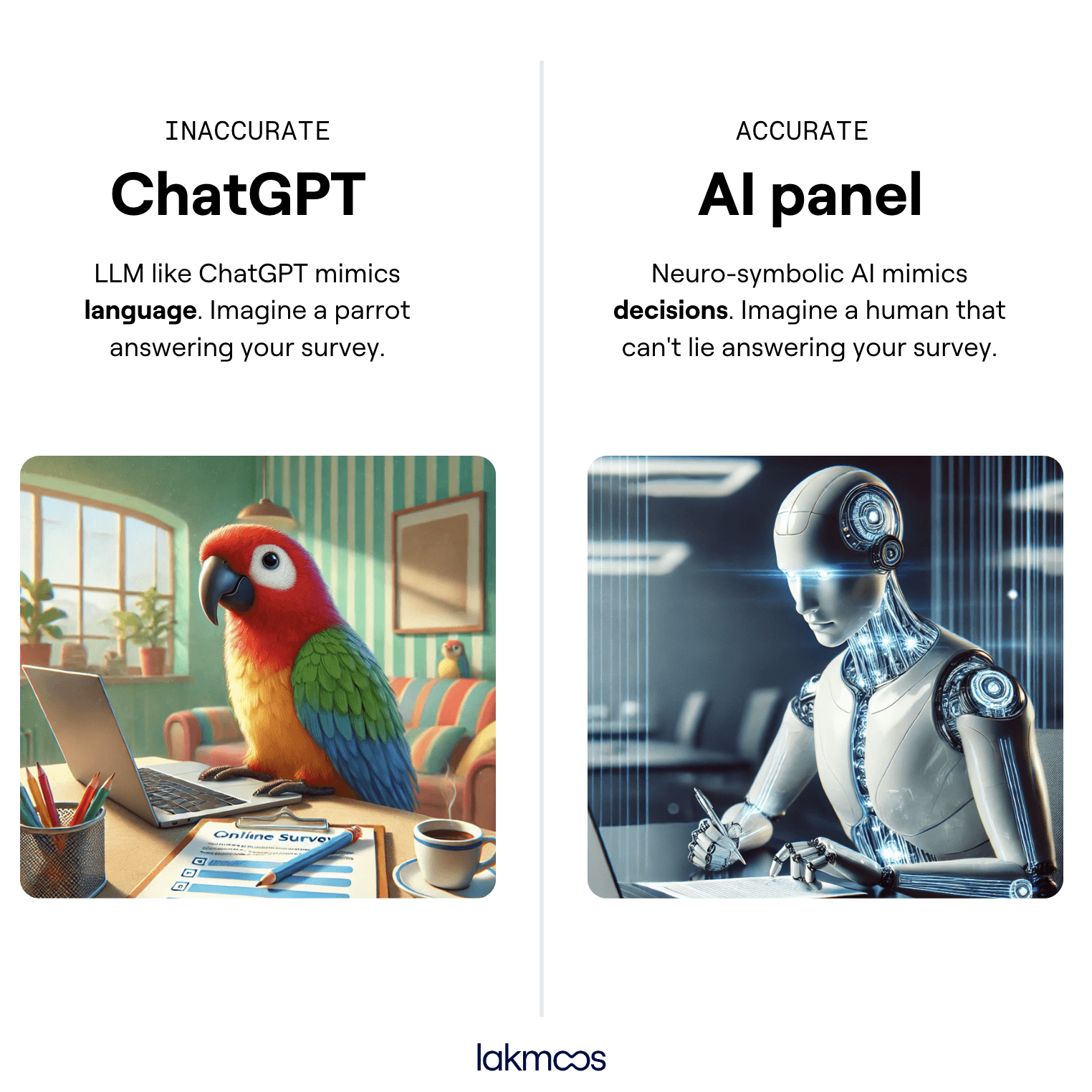
ChatGPT is trained on language, not behavior. Ask it to roleplay a consumer and it will give you plausible answers, because plausibility is the objective. But if your “AI panel” is just a fancy UI over an LLM, you’re not simulating a population. You’re just asking a well-read parrot to improvise.
That’s the case for most lightweight AI panel tools based on LLM and RAG like
They’re useful. But they’re not research-grade. And certainly not defensible in front of your CMO, compliance, or board.
In real research, you need more than fluency. You need consistency, logic, and traceability. When a synthetic persona gives one answer in the morning and a contradictory one in the afternoon, you’re not discovering truth, you’re generating content. And when that “insight” becomes a business case or comms decision, the risks aren’t just methodological. They’re reputational. Tools that simulate words aren’t equipped to simulate users. That’s the difference between a chatbot and a research system. And it’s exactly where Lakmoos draws the line.
🛠️ Prompt and Pray ≠ Methodology
The trouble with some prompted respondents is that they’re just fine-tuned puppets. There’s no consistent logic, no real-world persona structure, no grounded behavioral data.
You’re not running simulations, you’re staging performances:
Ask twice, get two different “truths”
Prompt harder, and it agrees with you
Change a word, derail the answer
The results can’t be validated. They can’t be audited. They can’t be trusted.
Which is fine - unless you want to actually make a decision.
Using GPT for user insight is a bit like asking your neighbor for product feedback. Sure, they’ll give you an opinion (and maybe even a convincing one) but it’s not representative, repeatable, or grounded in a real sampling method. At best, it’s convenience sampling with a smooth voice. In real research, we don’t make calls based on who happens to be nearby. We design panels. We control for bias. We measure. That’s the difference between plausible and trustworthy and exactly why we built Lakmoos.
🧬 Lakmoos Is Built to Simulate, Not Perform
We don’t prompt bots to roleplay. We simulate people making decisions.
Lakmoos AI panels combine:
Behavioral simulation: Our respondents mimic how real-world segments behave, not just what they say.
Neuro-symbolic architecture: Logic + language = better reasoning, fewer hallucinations.
Data-grounded personas: Our panels are structured from survey data, real psychographics, and observed patterns, not vibes.
Replicability by default: Ask the same thing, get the same modelled outcome, because we treat consistency as a feature, not a fluke.
It’s not generative for the sake of content. It’s generative for the sake of research.
This isn’t toy research. Lakmoos AI is used when:
You missed your research window and can’t wait 6 weeks to rerun
Your target is too niche for traditional panels
You need a first read before locking your campaign
You want to compare your hunches against behavior-driven simulation
Our clients don’t use Lakmoos to replace humans.
They use it where human-based research didn’t happen (or couldn’t).
🎯 When Chatbots Guess, Lakmoos Simulates
Here’s what makes the difference:
GPT wrappers are trained to sound like everyone.
Lakmoos is trained to think like someone.
We don’t improvise opinions. We simulate decisions.
We don’t pretend personas. We model them.
We don’t rewrite the question. We answer it, with explainable logic, grounded profiles, and repeatable results.
🧩 What You Lose When You Settle for Style
The illusion of insight can be dangerous. Sure, a GPT wrapper may give you speed and style. But it won’t give you:
Ground truth from past behavior
Internal consistency across segments
Confidence you can defend in a room full of skeptics
Accurate information about niche groups
If your AI panel changes its mind mid-slide deck, it’s not a panel. It’s a prop.
You don’t need more convincing answers. You need more convincable ones. That’s what we built Lakmoos for: research that stands up under pressure.
We simulate. We audit. We explain.
We don’t roleplay. We replace the silence where research should have been.
At Lakmoos AI, we build custom AI panels for enterprise-level companies who care about quality. Our neuro-symbolic AI models are grounded in behavioral theory, trained on real-world signals, and built for auditability. Because we believe AI panels shouldn't just be fast, they should be defensible, explainable, and genuinely useful. We generate signal instead of noise.