
In 2025, decisions are made faster than traditional research can keep up. Product, marketing, and CX teams are expected to personalize at scale, launch quickly, and respond to shifting consumer logic in real time. But most organizations still rely on:
Stale segmentation models
Delayed research reports
Assumptions passed off as “customer intuition”
AI panels offer an alternative: a way to simulate real-time, high-fidelity consumer responses before you invest resources, expose your brand, or commit to a direction.
What Are AI Panels (in C-Level Terms)?
Think of AI panels as behavioral simulators: systems that model how specific customer types would likely think, react, and decide based on structured, logic-driven profiles.
They are:
Faster than traditional research (minutes, not weeks)
More adaptive than static personas
More explainable than black-box generative AI
They give your teams the ability to test decisions before market exposure, without running live experiments on your brand.
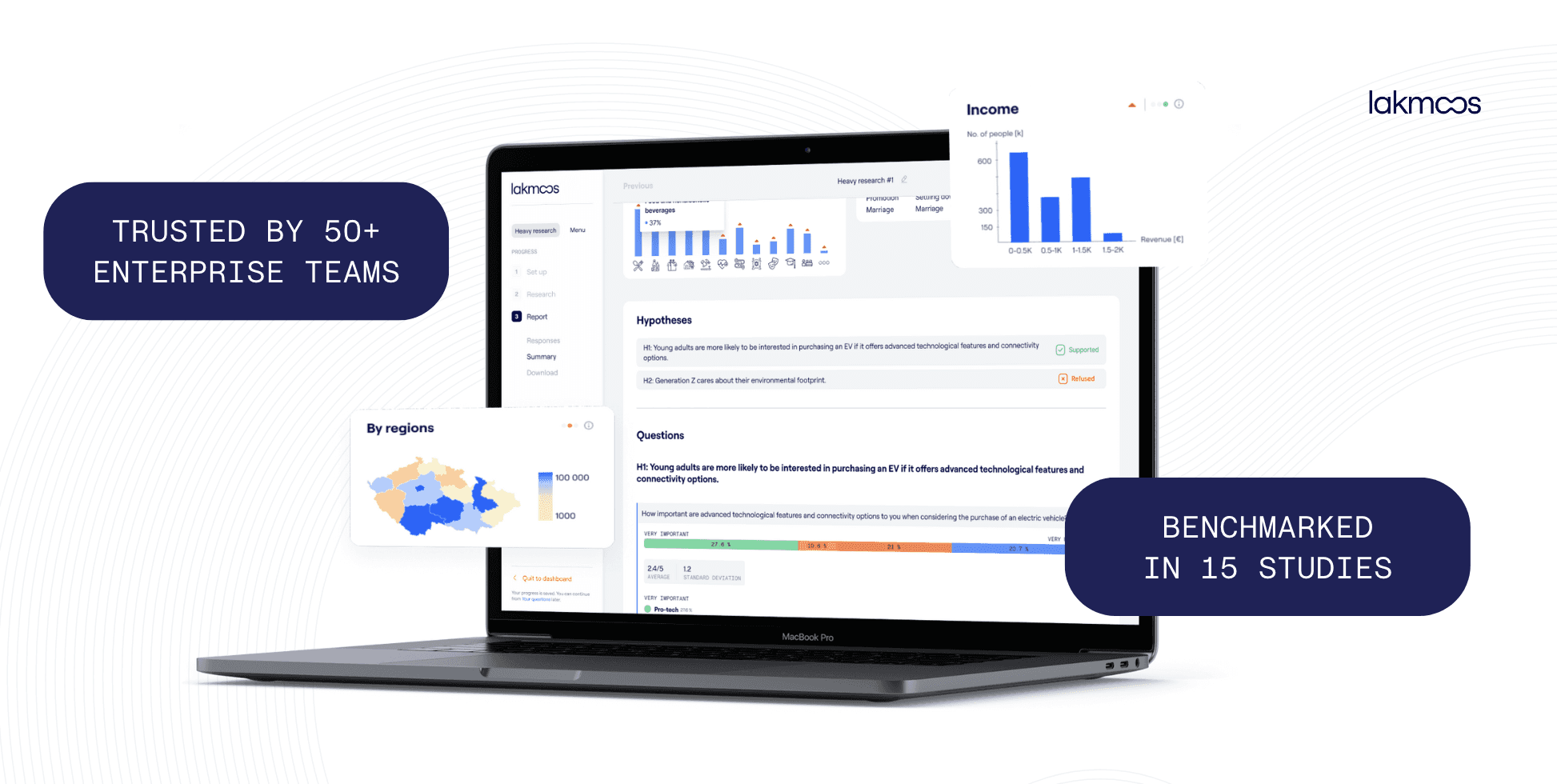
What C-Level Executives Need to Know
1. Speed ≠ Recklessness
AI panels like Lakmoos aren’t about skipping research—they’re about building confidence early, when it’s cheapest to pivot. They reduce reliance on loud opinions and mitigate post-launch regret.
2. Trust Is Earned Through Transparency
Quality panels simulate behavior using rule-based logic grounded in behavioral science—not scraped content or shallow averages. Unlike general-purpose LLMs, you can audit and explain what the model is doing.
3. Insight Becomes a Shared Capability
When AI panels are available to product, brand, and CX teams, they don’t have to wait for a research cycle. This shifts your org from knowledge silos to insight fluency. It’s a form of democratization—without giving up governance.
4. You’ll Get Alignment, Not Just Answers
In practice, the biggest ROI isn’t just faster answers. It’s alignment. When everyone’s using the same behavioral logic (legal, design, marketing) they argue less and decide faster.
Where to start?
Run a pilot on a real decision (e.g. campaign messaging, onboarding flow, product naming)
Include multiple teams, not just marketing or UX, but product owners and risk stakeholders
Evaluate not just insight quality, but workflow fit
Use your own language: strategic bets, segment strategy, channel allocation
Questions to ask before you invest in AI panels:
Is our current segmentation producing actionable, testable insight or just slideware?
How often do product, brand, or CX teams make decisions based on limited or delayed user feedback?
Do we have a safe, explainable way to simulate consumer response without live testing or research delays?
Are we treating user insight as a department or as a shared strategic capability?
Case in Point: Volkswagen Group & Raiffeisenbank
At Volkswagen Group, Lakmoos AI was used to create interactive personas, living models that helped creative and product teams test emotional resonance across future mobility segments. At Raiffeisenbank, AI panels enabled 40% more stakeholders to interact with simulated customers during a design sprint, accelerating decisions that previously required cross-departmental research cycles.
In both cases, the tool didn’t replace strategy, it made good strategy cheaper, clearer, and more repeatable.
Quality is Everything
While many AI panel providers promise speed or novelty, Lakmoos is built around decision quality. It doesn’t just simulate answers, it models how different people make trade-offs, hesitate, or change their minds. Unlike black-box LLMs or superficial survey bots, Lakmoos is logic-first, behaviorally grounded, and explainable by design. You can inspect how segments are built, why answers appear, and how decisions differ across profiles. That makes it usable not only by researchers, but by marketing, product, and even compliance without compromising trust, traceability, or governance.
→ We comply with ESOMAR 20 questions for AI providers.
Final Thought: Precision Without Delay
AI panels are not just a trend. They’re part of a broader shift toward decision intelligence: tools that let leaders simulate outcomes before they commit resources. For any C-level team under pressure to move faster without eroding brand trust, this is the bridge between speed and confidence.
You don’t need to automate insight.
You just need to make it always available without losing control.