
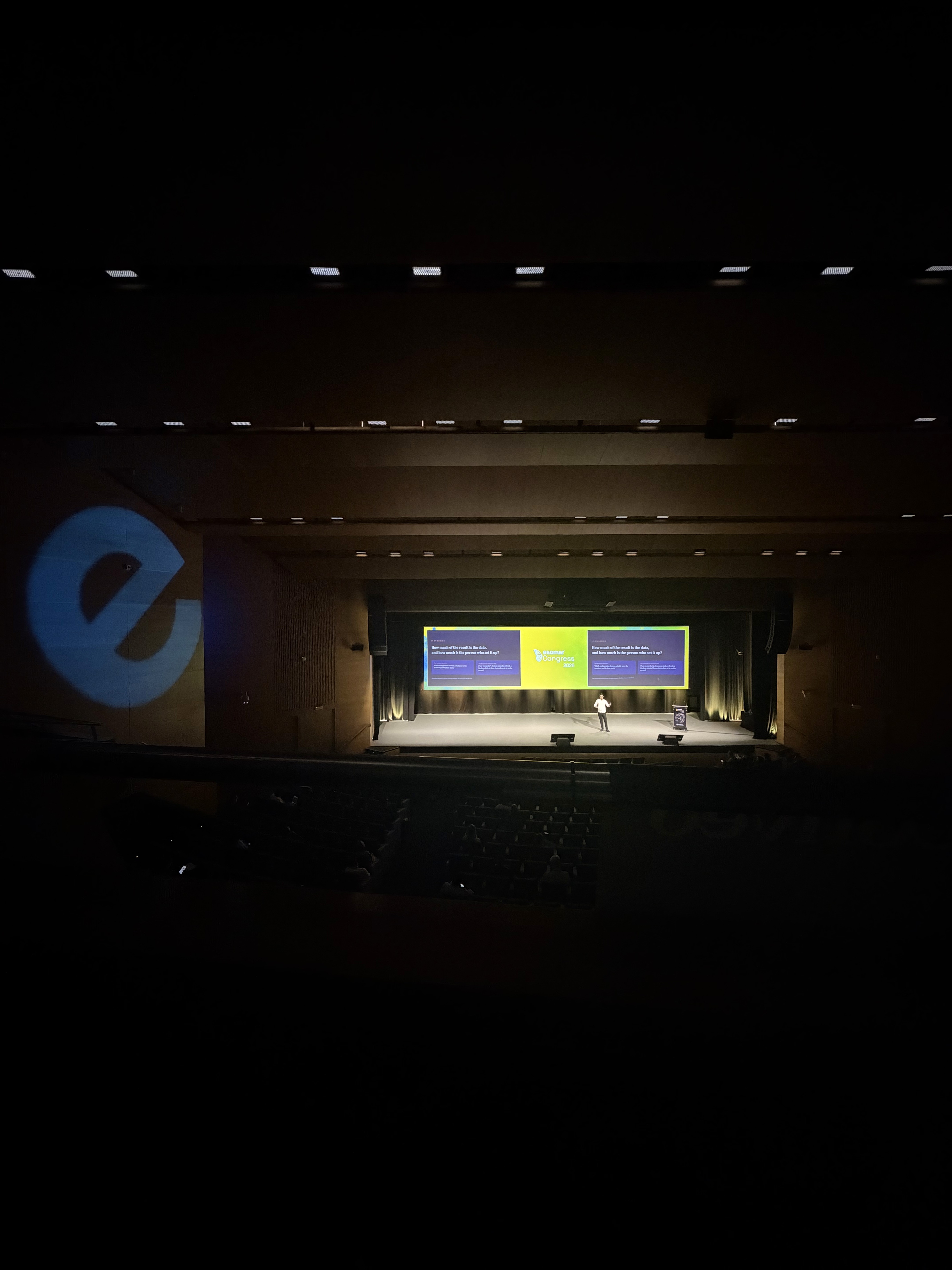
Esomar Congress 2026 took place from 1 to 4 September in Valencia, Spain, under the theme Metamorphosis. More than 1,200 insights, data and analytics professionals from over 80 countries attended. The framing ESOMAR chose was deliberate: not disruption, not replacement, but transformation of how human understanding, technology and practice fit together.
Lakmoos team brought two papers. They answer two different questions that turn out to be the same question.
In short:
Metamorphosis of Expertise asks what AI is doing to the people in this profession. The answer: the mechanisms that used to convert expertise into standing and pricing power are all breaking at the same time.
Tuned to Fit asks whether synthetic survey data can be trusted as currently reported. The answer: not yet, because the configuration that produces the data is almost never disclosed, and it changes the result.
Paper 1: Metamorphosis of Expertise
Author: Kamila Zahradníčková
Stage: Shift Stage, Esomar Congress 2026
The question
Everyone in market research can feel that something has shifted. Very few people can say precisely what. So this study went and asked, through in-depth interviews with agency founders, corporate researchers and association leaders, conducted in Czech and English across CEE, DACH, UK and global contexts, at junior through senior levels.
The concept: field hysteresis
Field hysteresis is a term from Pierre Bourdieu's field theory. It describes the lag between a change in the rules of a professional field and the ability of people inside that field to adjust to it. People are not slow or resistant. They are following rules that are no longer being rewarded, because nobody has rewritten them yet.
That distinction matters practically. If the problem is individual adaptation, the answer is training. If the problem is field-level hysteresis, training does not touch it.
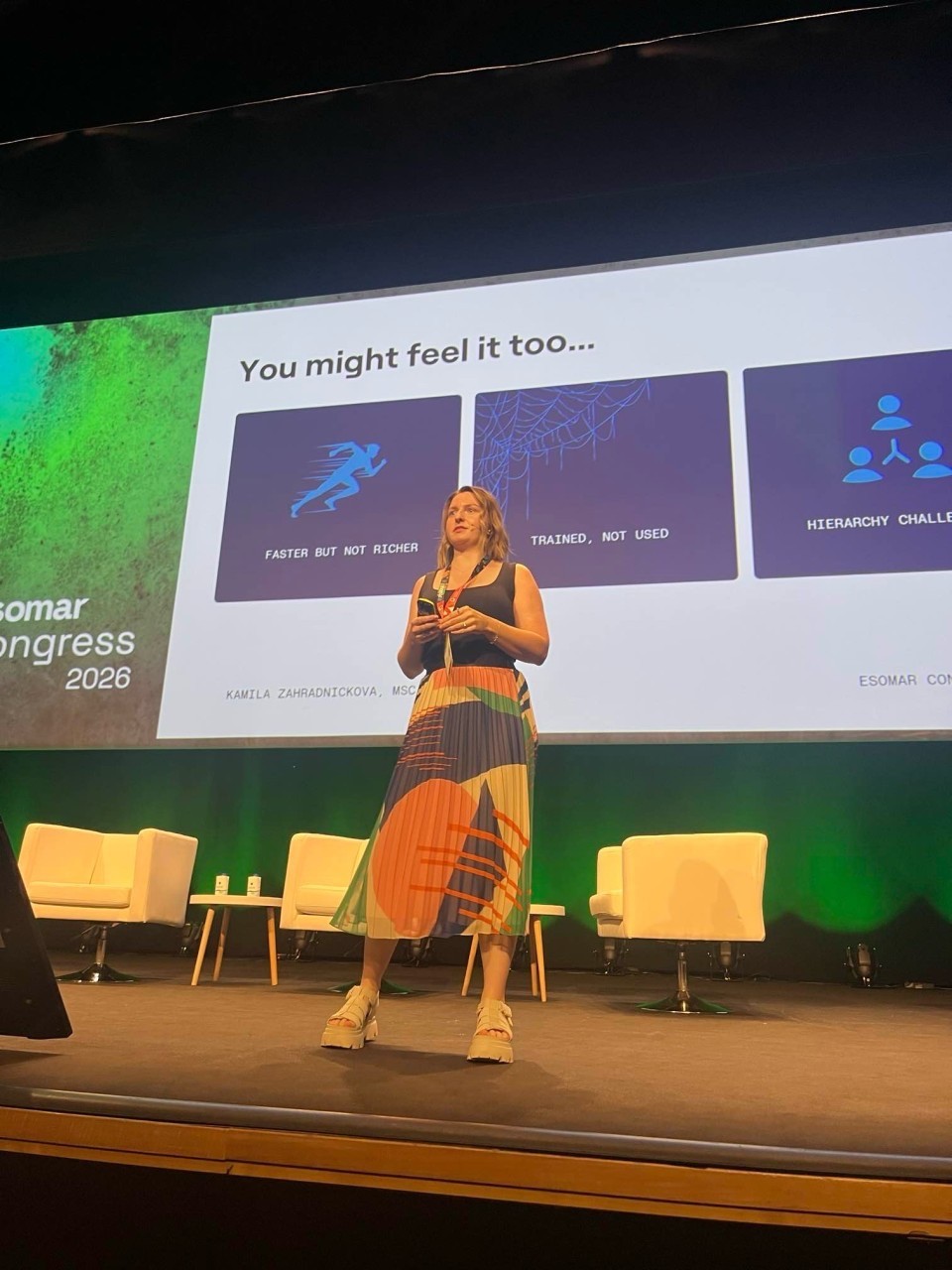
Kamila on stage at Esomar Congress 2026 in Valencia.
Three findings
1. AI entered from outside the field, and the work is being reclassified. Previous disruptions in market research came from inside the profession's own logic, vetted by its standards and taught through its training pathways. This one did not. It arrived from industries whose data and computing infrastructure let them define what good research looks like without asking. One junior respondent, finishing a master's in applied research methodology, described knowing the methods and rarely applying them: there is not much research anymore, more IT.
2. There is a say-do gap, and it is structural. Nearly everyone interviewed knows a leap is required. Almost nobody finds it easy to make. Research budgets have stopped growing while demand has not fallen, so the pressure lands on individual researchers to be more efficient with less. That is not resistance. It is a mismatch between the skills people have and the skills now rewarded.
3. All four capital conversions break at once. This is the analytical core. Value in this field used to reproduce along a predictable chain: expertise becomes reputation, reputation becomes pricing power, seniority becomes authority. AI did not break one link. It made all of them unreliable simultaneously, which is exactly why the moment feels disorienting rather than merely difficult.
Why it matters for insights leaders
The lag is in the field, not in your team. That reframe changes what you do about it. It also points to where the value moves: as AI absorbs production work, the researcher's remaining work becomes more visible, not less. Framing the right question. Catching the finding that does not fit. Turning insight into a decision. The job moves from doing research to orchestrating it.
Paper 2: Tuned to Fit
Authors: Matej Koreň, Radek Hranický, Kamila Zahradníčková, Jan Polišenský
Affiliations: Brno University of Technology, Lakmoos AI
The question
Silicon sampling is the practice of using large language models to generate synthetic survey respondents instead of, or alongside, human ones. The industry has adopted it quickly. This paper asks a narrow, testable question: how much does the result depend on configuration choices that go unreported?
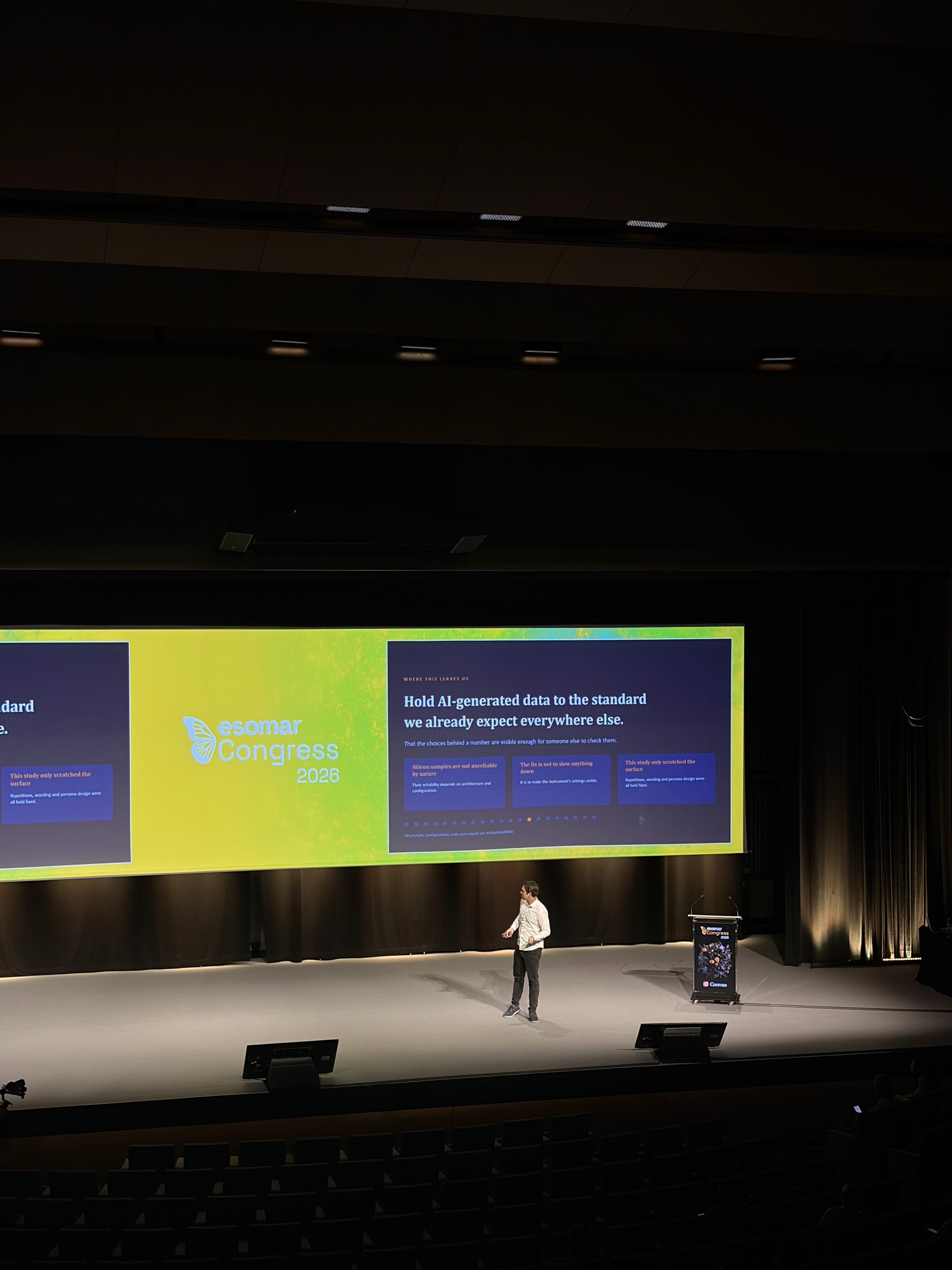
Jan on stage at Esomar Congress 2026 in Valencia presenting Tuned to Fit.
Three findings
1. Temperature alone moves the answer. Changing only the temperature setting shifted both the mean response and its spread, significantly, across most models and most test batteries. GPT-4.0 was the most volatile, with significant shifts in means on 12 tests and in variance on 14.
2. Which model is part of the method. Swap the model, keep the prompt identical, and the distribution changes again. The largest gaps between models showed up in the standard deviations, most visibly between LLaMA and DeepSeek. "The LLM said so" is not a methodology statement.
3. There is always a temperature that matches human data almost exactly, and it is never the one people report. For every model and every battery, some configuration produced near-zero error against real human responses, with mean squared error as low as 0.03 to 0.08. But the best-fitting setting differs by model and by trait, and it sits above the 0.0 default that most published work reports.
That third finding is the quiet problem. It means a synthetic sample can be tuned, knowingly or not, to confirm whatever the researcher was hoping to find. This is the same structure as the researcher-degrees-of-freedom problem that produced the replication crisis in psychology.
The proposal: five questions
The paper does not end with a warning. It ends with a minimum reporting standard, grouped into five clusters that map to five questions any reader should be able to answer about a synthetic study:
Model. Which model? Name, version, access method, date window.
Prompt. What prompt? How personas were built, the instruction, the response scale.
Settings. What settings, and what else did you try? Temperature and non-default parameters, plus the full range tested.
Choice and evaluation. Why this configuration? Pre-specified or post-hoc, against which benchmark and metric.
Repository. Where can I check it? Prompts, configurations, code and outputs at a persistent public link.
None of this is exotic. Machine learning research already expects this discipline, and language models are machine learning models. The scope here is deliberately limited to LLM-based silicon samples. Rule-based and hybrid architectures embed different assumptions and warrant their own treatment.
FAQ
What was the theme of Esomar Congress 2026?
Metamorphosis. Esomar framed the 2026 edition around how human understanding, technology and practice are evolving to shape better decisions and impact.
When and where was Esomar Congress 2026 held?
1 to 4 September 2026, at the Valencia Conference Centre in Valencia, Spain, with more than 1,200 attendees from over 80 countries.
What is field hysteresis?
A concept from Bourdieu's field theory describing the lag between a change in a professional field's rules and practitioners' ability to adapt. Applied to market research, it explains why experienced professionals feel disoriented rather than merely challenged by AI.
What is silicon sampling?
The use of AI to generate synthetic survey responses in place of, or alongside, human respondents.
Why does temperature matter in LLM-based synthetic survey research?
Temperature controls output randomness in a language model. Our experiments show it shifts both the average response and its variance significantly, which means it is part of the method and should be reported alongside the model and prompt.