

Labels are marketing. The model is the product.
TL;DR: Experiments showing that "digital twins" perform worse than plain ChatGPT guessing only prove one thing: LLM-based twins are LLMs. The accuracy of synthetic research is not determined by the label (digital twin, synthetic respondent, AI panel) but by the model underneath. A prompted language model produces plausible text. A validated population model produces a simulation. Those are different products.
The recurring experiment
Every few months, a new experiment makes the rounds. The setup is always similar:
Build digital twins of survey respondents inside a general-purpose LLM.
Ask the twins new questions.
Compare the results against simply asking the same LLM to guess the aggregate answers.
The guess usually wins, or at least ties. The conclusion is always the same: synthetic data is a scam, and a $20 chatbot subscription does the job better.
The finding is real. The conclusion is wrong.
These experiments do not compare synthetic data against AI guessing. They compare two prompting techniques on the same underlying model. The twins and the guess come from the same LLM, trained on the same data, carrying the same blind spots. The twin wrapper adds process, not knowledge, and the extra process adds noise.
What such experiments prove: prompting technique affects accuracy. What they do not prove: anything about synthetic research as a category.
Why the labels are meaningless
Synthetic personas. Digital twins. AI panels. Silicon samples. Synthetic respondents. AI respondents. Six labels, one supposed category, and no agreement on what any of them mean.
Buyers respond to this chaos in a predictable way: they pick a label and form an opinion about it. Digital twins are overhyped. Synthetic data doesn't work. AI panels are the future. Then an experiment attaches itself to one label, and the whole category takes the hit or the credit.
Pick whichever label your team likes. What matters is what's underneath.
Two products wearing the same label can have almost nothing in common:
One "digital twin" is a persona paragraph pasted into GPT.
Another is a statistical population model built on structured data, where a language model touches only the final sentence.
Same name, completely different machines, completely different accuracy. Arguing about the label is arguing about the packaging.
The only question that matters: math model or text generator?
Strip away the vocabulary and one question remains: is the thing underneath a validated math model, or a text generator?
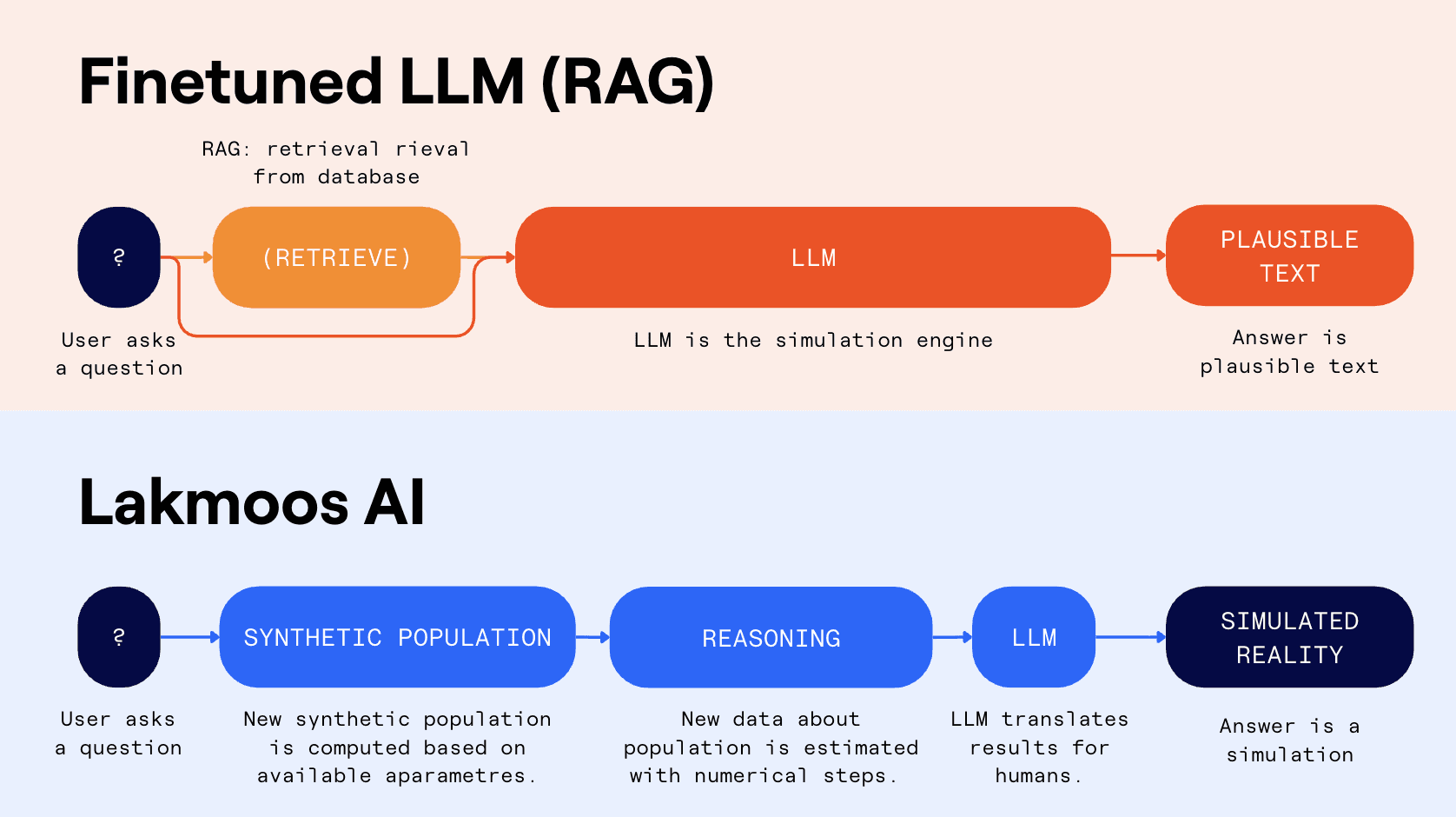
Why LLM-based synthetic respondents fail
An LLM is very good at exactly one thing: writing a plausible answer. Ask it what 2,000 drivers think about new EV pricing and it returns a fluent, confident, specific response. It is also making most of it up. Three structural problems:
No statistical baseline. An LLM does not hold calibrated data about a given market, only what people happened to write online.
No sampling. Asking an LLM to "be" two thousand respondents produces two thousand rewordings of the same central tendency, not two thousand independent draws from a population.
Fluent invention. Where the model lacks data, it fills the gap with confident answers rather than uncertainty.
None of this is fixed by better prompting. The experiments prove it by accident: wrapping the same LLM in twin personas does not add information, it adds two thousand opportunities to hallucinate. Autocomplete is not a tool for million-dollar decisions.
Doesn't RAG solve this?
RAG helps a bit. It lets the model read some data before it writes, so the answer is grounded in something. But the architecture is unchanged: the final step is still a language model generating text. It never decides who is answering, and it never reasons about why those people would answer that way. RAG changes what the model reads, not what the model is.
What a validated population model looks like
A population model is built the other way around. Before a single sentence gets written:
The system builds the population from structured statistical data with hundreds of linked attributes.
Rule-based reasoning works through how those specific people, with their context, constraints, and history, would actually respond.
The language model is the last mile, not the brain. It translates numerical results into readable sentences. It never generates the numbers.
Validation is continuous, not a launch-day paper. Every model layer gets checked, every new client benchmarked against their own real respondent data.
That is the gap between a plausible answer and a defensible one. One sounds right. The other holds up when someone in the room asks "where did this come from?"
The difference is measurable: 90%+ accuracy across 20 benchmarking studies against real human panels. Lakmoos models answer over 20 million questions a week, and every one of those answers traces back to data and rules.
What this changes in practice
The "does synthetic data work" debate misses the actual point. The goal was never to swap one data source for another. The goal is what happens to research when a validation cycle takes minutes instead of weeks:
Teams run roughly 10 iterations for every one they ran before.
One beverage client went from a shortlist of 10 product ideas to a validated top 2 in days, testing every step against a simulated population before touching fieldwork.
Product teams test twice as many concepts because testing stops being the bottleneck.
Research budgets drop by around 60%, but the more interesting number is how many decisions get validated at all instead of shipping on gut feeling.
Human research does not disappear in this picture. The ratio changes. Simulation absorbs the fast, iterative, exploratory work, and human fieldwork concentrates where it adds the most: final validation and depth.
Three questions to ask any synthetic research provider
The experiments are right about one thing. If a provider's synthetic respondents are prompted LLM personas, that is a markup on ChatGPT, and skipping the middleman is rational.
But that is a verdict on one architecture, not on a category. Before forming an opinion about digital twins, silicon samples, or whatever the next name will be, ask:
What generates the distribution? A population model or a language model?
Can every answer be traced back to its data?
How often is it validated against real people, and by whom?
Labels are marketing. The model is the product.
FAQ
Are digital twins and synthetic respondents the same thing?
The labels are used interchangeably, but they describe nothing about the technology. A "digital twin" can be a persona prompt in ChatGPT or a statistical population model. Accuracy depends on the architecture, not the name.
Why do LLM-based digital twins perform worse than direct AI guessing?
Because both come from the same model. The twin simulation adds no new information, only extra generation steps, and each step is an opportunity for noise and hallucination.
Doesn't RAG make LLM-based synthetic respondents accurate?
No. RAG grounds the text in retrieved data, but the final step is still a language model generating plausible text. It doesn't decide who is answering or reason about why they would answer that way.
Does synthetic research replace human respondents?
It rather changes the ratio. Simulation handles fast, iterative testing; human fieldwork concentrates on final validation and creative research methods like co-creation.
How is a synthetic panel validated?
By benchmarking simulated answers against real respondent data, continuously: per model layer, per client, per study. Lakmoos reports 90%+ accuracy across 20 benchmarking studies against real human panels.